This is one of several Fun Pix resulting from my experiences with Habitat For Humanity. |
|
| B A R E L Y B A D W E B S I T E |
|
This is one of several Fun Pix resulting from my experiences with Habitat For Humanity. |
|
Hammers |
| No doubt there's another page on the whole Internet devoted to
one person's hammer history, and no doubt it's more interesting.
I didn't set out to go on at such length about hammers.
Originally there were only two that I discussed, and somehow it just
grew to the point where I have something to say not only about all
my hammers but two other people's as well. 1984: This is the first hammer I remember owning, and I have a special
fondness for it despite its idiosyncracies. Although I didn't kn On a Habitat site in 2000 or so where we were attaching vinyl siding, someone borrowed this hammer and at the end of the day I couldn't find it. I looked for a long time with no luck. Then, because the siding had been attached incorrectly that day, about a month later while working on a house across the street I noticed a panel of siding was detached and flapping in the wind. I lassoed some roofing nails and my glass Vaughan replacement hammer (see below) and started slogging through the tall grass to get to the as-yet-uninhabited house when I stepped on -- you guessed it -- my Estwing leather. Someone had just set it down in the tall grass several yards from the house and walked away from it. That month of weathering hadn't done it any good. Part of one of the white, plastic rings at the top fell out, and as a result the leather at the bottom loosened slightly, but neither of those defects affects the way the hammer works. Worse is that now, every single time you hit a nail or anything else that isn't as soft as a bunny rabbit, the steel rings out a distinctive sound. The note that it peals -- C sharp three octaves above middle C, in case you're interested -- is both penetrating and loud, it vibrates for an impressively long time, and it is audible to people a remarkably long distance away. It's amusing for about the first three times you hear it. It's a lot less amusing by the time you've finished re-fencing your entire patio with your brother with it. Despite the fact it sings every time you whomp something with it it is still the only regular hammer, as opposed to framing hammer, I've ever owned. |
May 1998:
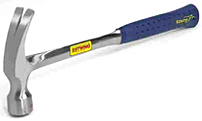 This
is the first hammer I bought for use in framing on Habitat sites, an Estwing
E3-28SM.
It's a common model used by pros. For a framing hammer I made
all the right choices but one. It's 16 inches long, versus
more like 12 for regular hammers. It has a straight, not a
curved, claw. It has a waffled face, not a smooth one. This
is the first hammer I bought for use in framing on Habitat sites, an Estwing
E3-28SM.
It's a common model used by pros. For a framing hammer I made
all the right choices but one. It's 16 inches long, versus
more like 12 for regular hammers. It has a straight, not a
curved, claw. It has a waffled face, not a smooth one.But the head is a whopping 28 ounces. When I picked it out and picked it up I didn't pay enough attention to the head weight. With this 28-ouncer, it took me just a couple hours of framing to realize I simply wasn't tough enough or strong enough to use it except in the best of circumstances, such as hammering straight down in the flow of gravity. When I'd climb a tottering ladder and get into some awkward position and try to hammer over my head, I could swing it really hard maybe half a dozen times before I needed to choke up on the handle or actually take a break for a few seconds. It was not gangs of fun, it was embarrassing. I gave that hammer to the Habitat affiliate, and one of the staff members began carrying it. He's six feet three inches tall, he weighs maybe 250 pounds, he's a professional rubgy player, and he looks like he could hammer nails with his biceps muscles. |
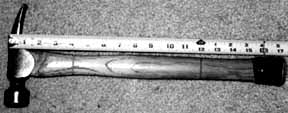
Update of June 1998: This is the second framing hammer I've bought. The head of this popular Vaughan California framer, model CF1, weighs 23 ounces, which is a whole lot less than 28. My Vaughan 23-ounce hammer is just right. It's enough heavier than my regular hammer's 20 ounces that those three extra ounces make a difference when you're flat-out whomping big nails or when you're just pounding as hard as you can on, say, an entire wall to get it to move (called "persuading"). The handle of this framing hammer is a good five inches longer than my regular hammer's, and that makes a big difference too. The tradeoff for that longer lever arm, though, is that when you hold the hammer at the far butt end it becomes harder to swing accurately, plus which it is effectively heavier than if you choke up on it. Novice hammererers choke up on the handle a lot and take sometimes two dozen weak swings at the nail, using only the wrist or, even worse, not using the wrist at all. Framing carpenters use all the power of physics and their anatomy to sink a 16d nail in five or four or even three powerful blows. It's even doable in one! At the other end of that scale, in 2004 I once watched a girl on a KCMO Habitat site who really was trying her best sink a 16-penny nail in 76 blows. Update of May 2010: This record has been topped. On a Truman Heritage site a person, also a girl, who was also trying, took 121 blows. This hammer stands out in my memory for a reason I will never forget. One afternoon on a Habitat site this cute girl and her cute friend wanted to use this hammer to pound a nail. I challenged them to a contest to see who could sink a nail in the fewest blows. I started, and it took me maybe -- I don't remember -- six blows. I got a nail started for the first girl, and she got it sunk in maybe 20. The second girl, who'd never used a hammer in her life, said she wanted to use both hands and take one really powerful blow. I said sure, and she raised the hammer well over head while I held the board with my left hand, about a foot away from the nail, because I knew such a powerful impact would bounce the board around. I encouraged her to swing as hard as she could. She let loose with all her might and -- to my astonishment -- she hit the nail. Of my left index finger. That fingernail eventually fell off, of course, but the replacement grew in funny and eventually it fell off too. It was about two years before a normal nail grew in, and -- truth be told -- I now regard the nail of my left index finger as one of my more appealing bodily features. Perfect strangers, and a few imperfect ones, are all the time sidling up to me and saying stuff like, "OMG, that is the single most attractive fingernail I have ever seen in my life. I will give you a 30-gallon trash bag stuffed with cash if you will father my children." The face of a framing hammer is a good 25% bigger than that of a regular hammer, which would be a problem in many tight or delicate nailing situations, but in framing it doesn't matter if you beat up the wood around the nail. And because the face is bigger, you don't have to be so accurate, which means you can afford to take a longer and more powerful but perforce more error-prone swing. As you might be able to tell from the photo above, I have incised (using a #10 scalpel) a ring into the handle at a point four inches from the top of the head, one at twelve inches and another one at sixteen inches, which means I can make a quick and dirty one-shot measurement of 4 inches, 8 inches, 12 inches and 16 inches. At the eight-inch mark on the steel tape you'll see where the wood finish goes from light to dark. The dark part is where I sanded down the veneer on the handle, to give a better grip. And at the very bottom you'll see what turns out to be several windings of electrical tape, which serves two purposes. One is that it keeps the end of the handle from slipping through my hand, and the other is that, if I need some electrical tape, maybe as a makeshift depth-gauge for a drill bit, all I have to do is unwind some and tear it off. And I've roughed up the finish on both cheeks of the head so I can write down measurements on them (Was it 53 5/8 or 55 3/8?) and then erase them with a swipe of my thumb. A framing hammer does more than whomp nails. ● You can use it to extend your reach when you're supporting the weight of, say, a roof truss that you're handing up to the people on the top plates. ● You can use it to reach across a distance and plunge the claws into a piece of lumber so you can lift it up and carry it to you. ● You can use the claw end to wrap around a recalcitrant piece of framing and tow it into place. ● You can use the claw end to pull yourself into an awkward position, such as up a ladder that's placed way out of your mere arms' range. ● You can whomp the claw end into any nearby piece of wood just so it'll stay put for a sec while you do something else with your hammer hand. ● In conversations with fellow carpenters you can use it to point to and even touch various framing members that you couldn't otherwise point to accurately (just as you can use a steel tape, also shown in the photo above, to point to and touch things that are even farther away). ● You can shove the claw end in between two boards and move the handle sideways to pry them apart, like a pry bar. And it makes a heck of a paperweight. I really like my framing hammer. I've even named it. |
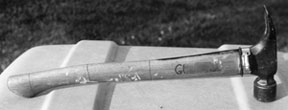 Update of July 2002: I've now bought a third framing hammer, an even better one. This is one of the original brand, called a Death Stick. Since then larger, more reliable manufacturers have copied the basic features and improved the product considerably. From the factory the head weighs 24 ounces, which is just right considering how well balanced it is. The Vaughan framer has a straight handle, but this one has what's called a hatchet handle, which naturally helps prevent it from sliding past the heel of your hand. When wielded taking full advantage of physics, it delivers an impressive blow. Fresh off the shelf it's all painted a shiny black, with "Death Stick" painted on both sides in huge silver letters. I've modified this particular version, of course. I sanded off the slick paint (which was a moronic design error), and I added ruler markings at 8, 12 and 16 inches on the handle, this time using a woodburning tool. And I burned in my name too, so I don't have to re-write it every other day with a Magic Marker. I've also added a feature that, in this exact implementation, as far as I know, I invented first. Just below the head you'll see a silver strap. It's a hose clamp wrapped around a ring of rubber hose, and the purpose is to protect the part of the handle just below the head. If you swing just a bit long you wham the handle into the nail head, and if that handle is made of wood or fiberglass it gets worn down over time, which can eventually cause it to break. Which is why I added a hose clamp right where it's needed. Any overstrikes that would chew away the wood of the handle must now pass through a layer of steel and a layer of rubber first. See the section below about Doug Stephens' hammer to see why this makes a difference. 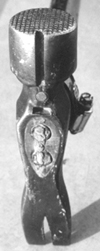 But
the coolest two features of the Death Stick use magnetism.
Here's a photo of the hammer's pate. At the top of the waffled
face you see a channel cut into the whole barrel, and below that you
see a small disk. That disk is a magnet, and if you merely
place it on a ferrous object such as a nail, it will pick it up.
This feature alone is handier than you might think. Instead of
bending over all the way to pick up a nail on the deck you can bend
over 12 inches less, or you can or reach over an obstruction 12 inches farther. But
the coolest two features of the Death Stick use magnetism.
Here's a photo of the hammer's pate. At the top of the waffled
face you see a channel cut into the whole barrel, and below that you
see a small disk. That disk is a magnet, and if you merely
place it on a ferrous object such as a nail, it will pick it up.
This feature alone is handier than you might think. Instead of
bending over all the way to pick up a nail on the deck you can bend
over 12 inches less, or you can or reach over an obstruction 12 inches farther.
But what about that channel? Here's the deal. You can
place a nail in that channel, and the magnet will hold it in place.
The head of the nail rests against a pocket just past (below, in
this photo) the magnet.
With a nail so loaded, you can then wham the top of the hammer face,
where the nail point is, into a spot perhaps a foot beyond where you
could reach with just your two hands, whence you can continue
hammering it in. If that saves you one whole ladder move, that
can be a big deal. |
Update of September 26, 2009: I have something to say about yet
another hammer. Well, two, actually. At right is my stay-at-home fiberglass hammer.
It's made by Vaughan, it's 14 inches long, the head weig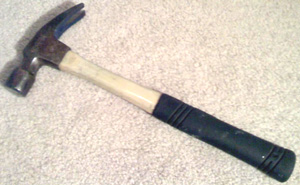 hs 20
ounces, and it's a fine hammer that I carried for a couple years on
Habitat sites. It's a useful hybrid of a regular hammer and a
framing hammer. The head weighs 20 ounces, which is just
between a regular hammer and a framing hammer. The length is
14 inches, which is again a compromise between the two types.
The face is the regular size, not the big size, which makes it
useful in more situations, and that face is smooth rather than
waffled, which also makes it useful in more situations. I
gave up this hammer on job sites only because I decided to carry
either a regular hammer or a framing hammer in my tool belt, but if I had to carry
only one for everything it would be this one. I can't imagine
you'd care -- I know I don't -- but the model number is
FS-999. hs 20
ounces, and it's a fine hammer that I carried for a couple years on
Habitat sites. It's a useful hybrid of a regular hammer and a
framing hammer. The head weighs 20 ounces, which is just
between a regular hammer and a framing hammer. The length is
14 inches, which is again a compromise between the two types.
The face is the regular size, not the big size, which makes it
useful in more situations, and that face is smooth rather than
waffled, which also makes it useful in more situations. I
gave up this hammer on job sites only because I decided to carry
either a regular hammer or a framing hammer in my tool belt, but if I had to carry
only one for everything it would be this one. I can't imagine
you'd care -- I know I don't -- but the model number is
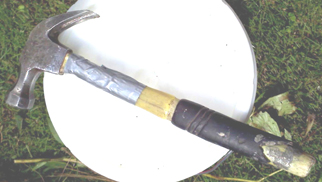
FS-999.Now, in comparison, below is Doug Stephens' hammer, which has been volunteering at KCMO Habitat sites on many Saturdays for many months now, along with Doug Stephens himself. Doug runs a gutter-installation business by day, he rehabs houses elsewhen, and he's a farmer, so there isn't much about building and re-building a Habitat house he doesn't know or can't figure out. Farmers. If you're a city feller like me, you might not
appreciate what farmers know. If I have the choice between a
Harvard-educated engineer and a high-school dropout who grew up on a
farm, and if I need something done on a Habitat site, I will choose
the kid who grew up on the farm every time. If you grew up on a
farm and helped do stuff and fix stuff and build stuff, you may stop
reading this paragraph (although you might not realize that lots of
city folk don't know what you know). Kids who grow up working
on a working farm learn at their parents' knees how to I've learned a lot from watching and working with Doug. On all but the rarest of Habitat job sites, Doug is the only person who's skilled and experienced and, frankly, brave enough to "walk the plates," which means walking along a 5-1/2-inch- and sometimes a 3-1/2-inch-wide board 8 or more feet up in the air with nothing but air to grab onto, often carrying heavy or unwieldy tools and even hoses and extension cords, which can get stepped on or get caught and throw you off your balance, and bending down or leaning over to perform work while up there. He's easy-going, he's a master craftsman, and he usually makes me laugh once or twice a day. But more important is that his hammer also makes me laugh once or twice a day. As you can see, both mine and his are Vaughans with fiberglass handles, and they're both 14 inches long. His is a model FS-20, which means it has a 20-ounce head just like mine, despite his cocksure assurances that the FS-20 weighs more. But as you might not be able to see, the top of Doug's rubber handle has slipped down about half an inch. And, as you certainly can see, it is really chewed up at the bottom, to the point where his hand is grabbing a lot of fiberglass rather than rubber. Moving up, you can see that the top of the shaft of Doug's hammer is wrapped in duct tape. Its purpose is to keep the fiberglass underneath it, which at this point is thoroughly splintery from so much use going into and out of a metal hammer loop, from stabbing fiberglass shards into his hand every time he reaches for it or puts it back. This is a curved-claw hammer, whereas all my hammers are of the straight-claw variety. Curved-claw hammers are stupid all day long compared to their better-designed brothers, and here's why: • As mentioned above, with a straight-claw hammer you can plunge the claw into wood and pull it towards you or just let it hold your hammer for a moment. This is significantly more difficult with a curved-claw hammer, and if you do get it plunged in deep enough to stick, the smaller angle of the handle tries to unplunge it by tearing the wood. • As also mentioned above, you can use the claw end of a straight-claw hammer as a pry bar to separate two pieces of wood laminated together. This is significantly more difficult with a curved claw. It's more difficult to get the claw between the boards to begin with, and if you do get it it deep enough, the handle is at a really bad angle for swiveling it the way you want. • In the process of attaching vinyl siding it is too-often necessary to remove a nail you've sunk. One of the surest ways is to place the claw of one hammer pointing down and hooked behind the siding so it will straddle the nail, then hit down on the face of that hammer with another hammer or even the heel of your hand. If I've described this properly, you can see how this won't work nearly as well with a curved-claw hammer. • But most important is the most important function of a claw,
which is, of course, to remove nails. According to my best
guess, a curved-claw hammer will work in Finally, and most important, Doug's hammer is flat-out broken at the neck of the handle. As you can see from the photo at right, taken September 26, 2009, and enhanced with red lines, the axis of the handle, which is supposed to be at a right angle to the axis of the head, is not. Well, anyway, Doug is an example of the maxim that it's a poor carpenter who blames his tools. Even with this one really poor tool, Doug gets way more done than I do with my whole arsenal of non-defective hammers.
At left is a picture of Doug holding the now thoroughly broken hammer. Shortly before this photo was taken he honored me by presenting this hammer to me as a gift. And at right is what it looked after I tried to hammer one more nail. You don't need red axis lines to see that its medical condition has gone from slightly anemic to dead.
Update of September 27, 2009: It's hard to believe but I now have another hammer to report on. (I didn't mean to get obsessive about hammers, but apparently I can't stop.) This is about Joe's hammer. Joe, 19, was hired by the construction department of Habitat Kansas City as an intern for the summer of 2009, and I got to work with him a fair amount. Joe tried hard, he was eager to learn, and I never saw him in a bad mood. I always looked forward to his company, and I suspect everyone does. Joe was born handy (accidental pun) for work on job sites. Every so often you need someone on a job site who's tall, often to hammer something that's just out of normal people's reach. And every so often you need someone on a job site who's left-handed in order to hammer something that is up against an obstruction to its left that prevents a full right-handed swing. Joe was born both tall and left-handed. Also, apparently he was born a good basketball player. Anyway, a few months ago Joe showed up one day on a job site during its framing stage with a brand new hammer, one he'd paid for himself. I commented that it was the same model I had bought 11 years before, which happens to be that Vaughan wooden framing hammer I described above. I mentioned that I had improved mine with rings, and that was the end of the conversation. J • I woodburned his name into the girl end of the handle. (It's called the "girl end" because novice hammerers who are girls tend more often than boys to choke up on the hammer way too far, which of course makes it easier to hit the nail every time but which also makes it way, way more difficult to hit it hard. Joe's hammer -- and this is true of every carpenter's hammer -- is designed to be grasped quite near the butt end.) The other side of the hammer now says "Joe," and the butt now says "23." • I sanded off the slick varnish. (I don't understand why any hammer manufacturer would intentionally add a layer of something slicker than wood to the handle of a wooden-handled hammer.) • I woodburned rings at 8 inches, 12 inches, and 16 inches from the top of the head. (Why don't hammer manufacturers go ahead and make these marks themselves?) Well, anyway, it was fun to meet with Joe and his aunt and his boss and have him read this Web page and then ceremonially present him with his now-found and now-improved hammer.
The difference is that I've now taken a woodburning tool to it. The annuli at 4, 12 and 16 inches are darker, and I've added a sort of grippy yet delicately artistic decorative surface to the handle, don't you agree?
I can't promise I will never have anything more to
say about hammers, Click the
Previous link to go back. |
| B A R E L Y B A D W E B S I T E |
|

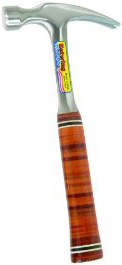 ow
it when I bought it, apparently it is considered
a classic. It is the Estwing
ow
it when I bought it, apparently it is considered
a classic. It is the Estwing
 use a hammer
and a screwdriver and various saws and ropes and wood and metal and
spit and baling wire. They learn, as a matter of routine, how
to diagnose and fix problems having to do with the physical world
such as fences and engines and pulleys. Farmers are unafraid
to tackle problems that city folk would immediately refer to an
expert who will charge a fee to patch the roof or unclog the drain
or replace the post under the sagging front porch. Farmers
are the experts.
use a hammer
and a screwdriver and various saws and ropes and wood and metal and
spit and baling wire. They learn, as a matter of routine, how
to diagnose and fix problems having to do with the physical world
such as fences and engines and pulleys. Farmers are unafraid
to tackle problems that city folk would immediately refer to an
expert who will charge a fee to patch the roof or unclog the drain
or replace the post under the sagging front porch. Farmers
are the experts.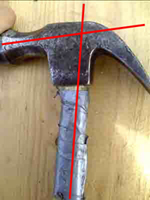 only about 75% of those
situations where a straight-claw hammer will work 100% of the time.
I ask again, why were curved-claw hammers ever invented? What
do they do that a straight-claw hammer doesn't do as well or better?
only about 75% of those
situations where a straight-claw hammer will work 100% of the time.
I ask again, why were curved-claw hammers ever invented? What
do they do that a straight-claw hammer doesn't do as well or better?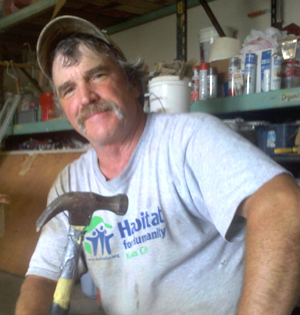
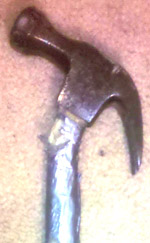 Doug's
hilarious hammer has finally succumbed to physics. He hammered one too many
times and it cracked beyond repair.
Doug's
hilarious hammer has finally succumbed to physics. He hammered one too many
times and it cracked beyond repair.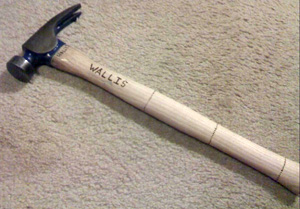 oe's last day as an intern was a few weeks ago, and it turns out
he forgot he'd left his hammer behind. Thanks to the help of
Habitat employees Kathie Wallis and Jim Wright, I managed to get hold of Joe's
hammer, and I improved it just as I have improved mine.
oe's last day as an intern was a few weeks ago, and it turns out
he forgot he'd left his hammer behind. Thanks to the help of
Habitat employees Kathie Wallis and Jim Wright, I managed to get hold of Joe's
hammer, and I improved it just as I have improved mine.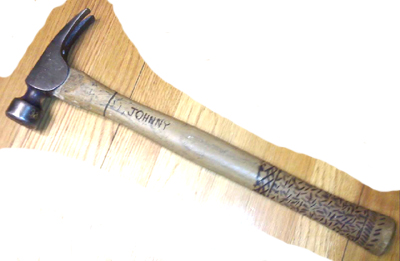 Update
of January 23, 2010: I've
given up explaining why I can't explain why there's yet another
image of a hammer shown on this Web page. Worse, it's the same
hammer as the one shown in the update from June of 12 years ago.
Update
of January 23, 2010: I've
given up explaining why I can't explain why there's yet another
image of a hammer shown on this Web page. Worse, it's the same
hammer as the one shown in the update from June of 12 years ago.